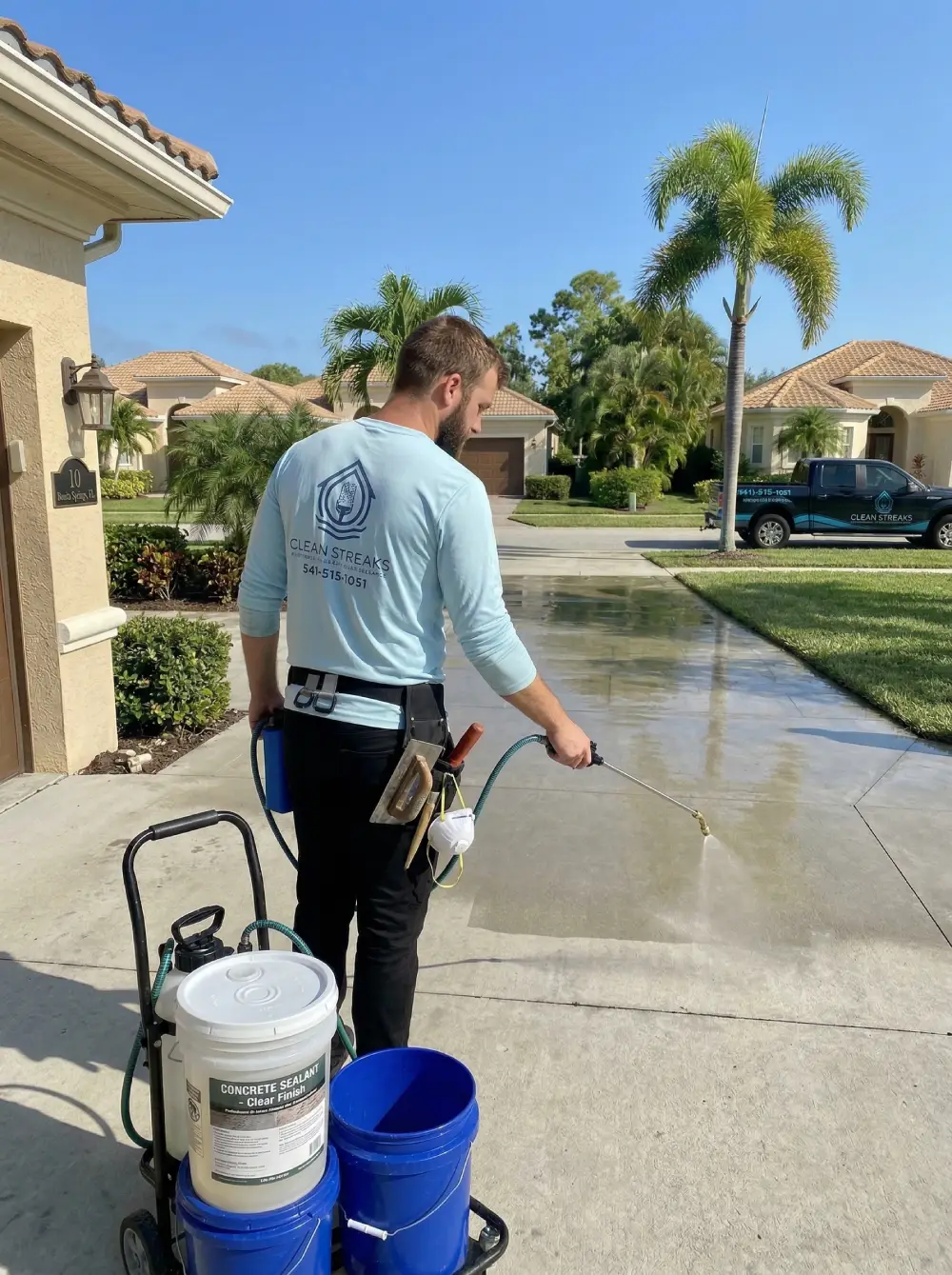
Clean Streaks is an exterior cleaning company in Bonita Springs that treats concrete sealing as one of its most process-intensive services. Before sealer touches a surface, we walk the property, test the concrete, remove contaminants, correct what can be corrected, and select the right product based on surface type, finish goals, and Florida conditions. That preparation is what separates a result that holds from one that fails within a year.
Concrete sealing addresses problems that compound quietly. Faded surfaces, failed old coatings, rust stains, oil stains, algae, mold, lichen, red staining from tree debris and fallen nuts, efflorescence, and moisture-related discoloration all need to be dealt with before new sealer goes down, or they get trapped rather than corrected. For most concrete surfaces, we lean toward a natural-looking penetrating sealer, though the right recommendation always depends on the surface condition, your finish goals, and what the concrete actually needs once someone has looked at it properly.

Concrete sealing is not flat-rate work. Two driveways that look identical from the street can require very different amounts of labor once an inspection surfaces what is actually going on. For a two-car driveway, $700-$800 is a reasonable starting point, though the final number depends on the actual job. Factors that shape pricing include:
Every item on that list means additional labor, materials, or time. We prefer in-person estimates whenever possible. The property gets walked, photos and notes are taken, and the quote is sent by email and text through our customer management system (CRM) with a follow-up afterward. Concrete sealing cannot be priced accurately from a photo because stain depth, trapped moisture risk, and prep needs are not visible without a real on-site inspection.





Concrete driveways take constant abuse from vehicle traffic, Florida sun, irrigation runoff, and organic debris falling from the trees above. For most driveway surfaces, we lean toward a deep penetrating, natural-looking sealer that protects from within rather than forming a surface film that can peel or trap moisture. Before sealing begins, most driveways need correction work for failing old sealer, oil stains, rust, organic buildup, efflorescence, and debris in cracks or joints. The sealer does not fix those problems on its own. They have to be addressed during prep, or they get locked in permanently.

Pool decks handle more moisture, more direct sunlight, and heavier foot traffic than almost any other residential concrete surface, all of which affects the prep plan, product selection, and how long the sealer will realistically hold. One important Florida-specific point: applying sealer when moisture is still sitting inside the concrete can produce a milky or cloudy appearance that does not resolve on its own. That is a key reason solvent-based sealers are avoided on most Southwest Florida jobs in favor of water-based products that allow the surface to perform as intended.
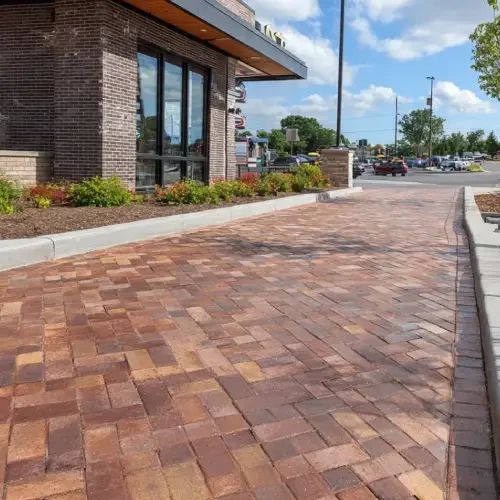
We apply the same foundational process to pavers, natural stone, and travertine, with treatment details varying by material. For most concrete surfaces, a natural-looking penetrating finish works well. For pavers, a water-based two-part system with joint-stabilizing properties is often the better fit, locking in joint sand, stopping weed growth, and preventing shifting while delivering your desired finish. Wet-look and higher-sheen results are available depending on the substrate. We stay focused on concrete and closely related exterior hardscapes where this prep-first sealing process performs best.
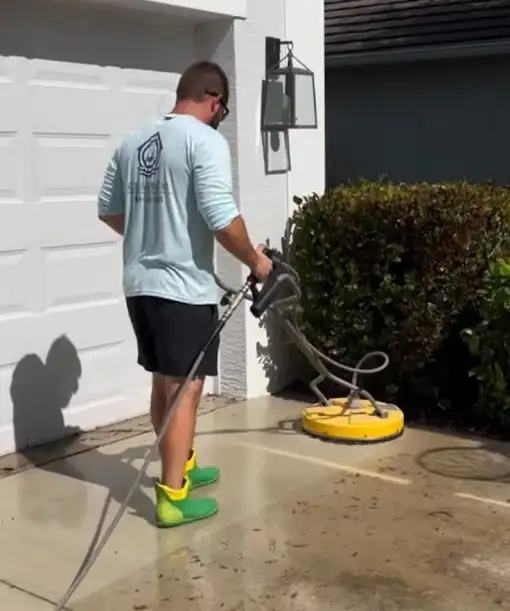
We do not apply sealer over a surface that is not ready for it. Prep includes inspection, water testing, stripping failed coatings, treating stains, removing organic growth, correcting efflorescence, thorough cleaning, sanding where needed, and full drying before sealer is introduced. Cutting any of those steps short affects how the product bonds, what the finished surface looks like, and how long the result holds.

Humidity, heat, rain risk, and subsurface moisture all factor into product choice and application timing. Solvent-based sealers can trap moisture and produce the milky, clouded finish that signals something went wrong beneath the surface. Water-based products suited for Southwest Florida hold up better when applied under the right conditions. If humidity or rain risk is too high on a scheduled day, the job gets rescheduled rather than pushed through.

Some stains come out cleanly. Others, particularly deep oil stains that have soaked into concrete over years, cannot be fully removed regardless of the products applied. We evaluate what is realistic during the inspection and explain the limitations before work begins, so you can make informed decisions rather than rely on best-case promises.
We discuss finishing goals before application begins so expectations are settled before the sealer goes down. For most concrete, a natural-looking penetrating finish is the right call. Customers who want a deeper color or wet-look result can achieve that through additional coating steps where the substrate supports it. Finish decisions are made upfront, not improvised on the day of application.

We answer the phone, return texts quickly, show up on time, and follow up in writing after the estimate and again after the job is complete. That consistency shows up repeatedly in customer feedback and is a genuine competitive differentiator in this market.

During sealing, adjacent surfaces are wetted down, a water shield is used near columns and pillars, overspray from the water-based product is rinsed before it sets, and sealer is cut in carefully around sidewalks, doors, and entry points. The result should improve the sealed surface without leaving a mess elsewhere on the property.

Concrete sealing done properly involves multi-step prep, premium products, precise application timing, and post-job follow-up. We are not the cheapest option and are not trying to be. Customers who want dependable results and a professional experience throughout the process will find that reflected in every step of the job.


The process starts before any equipment is unloaded. We return calls and texts quickly, prefer in-person estimates, and walk the property before confirming any scope. A water test checks for existing sealers, because that finding changes the entire plan. We also inspect for oil stains, rust, algae, mold, lichen, red staining from tree debris, efflorescence, and cracks packed with weeds or compacted debris. Needs that are not visible in a photo only become clear once someone is on-site evaluating the surface directly.
If the water test reveals an old sealer, it may need to be stripped before resealing can proceed. Applying new sealer over a failing coating creates problems that require starting over. The correction phase then targets what is actually on the surface: oil and rust stains are treated, organic buildup is removed using algaecide, sodium hypochlorite, or Wipeout as appropriate, and efflorescence is addressed with targeted products. Nothing that can be cleaned out should get sealed in.
After correction, the surface is cleaned thoroughly, joints and cracks are cleared, and additional brightening work with sodium hypochlorite (SH) or Wipeout is applied where needed. Then the surface dries completely before anything else proceeds. Moisture left in the concrete compromises how the sealer bonds and can produce visible defects in the finished result. If the weather is not cooperating on the scheduled day, the timeline shifts rather than the standard slipping.
For projects where joints are part of the surface, joints are sanded to roughly 1/8 inch below the lip, hydro-packed so the sand sits firmly, and allowed to dry before sealing begins. This step does not apply to every concrete job, but where joints are involved, getting this prep right directly affects how well the finished result performs over time.
Application begins with a flood coat that fills the surface and establishes the base. If more sheen is the goal, a second coat is applied after approximately 1 hour, followed by a top coat to complete the build. A natural-looking penetrating finish typically requires fewer layers than a wet-look result. Throughout application, adjacent surfaces are wetted down, a water shield protects nearby features, overspray is rinsed before it sets, and sealer is cut in carefully around columns, pillars, sidewalks, and doors.
We frame concrete sealing as a 2-day process to account for prep, application, and curing. Customers are advised to stay off the surface for 24 hours. After the work is complete, we perform a final walkthrough and follow up within a day or two. We also check back around the 6-month or yearly mark to see how the surface is holding up and whether any maintenance is worth considering.
We back our concrete sealing with a 2-year workmanship-style guarantee. Here is what that covers and where the limits are:
Being upfront about that distinction protects both parties and keeps expectations realistic from the start.
EXCELLENTTrustindex verifies that the original source of the review is Google. Great experience with this pressure washing company. They arrived right on time, were professional, and did an excellent job. Everything looks noticeably cleaner and they paid attention to the details. Reliable service and quality work—I’d definitely recommend them.Posted onTrustindex verifies that the original source of the review is Google. Daniel is excellent and works fast. Semper Fi !!!Posted onTrustindex verifies that the original source of the review is Google. I have used Holliday's PWS several times for roof (barrel roof), house, & gutter cleaning. Daniel and his team are always professional, punctual, respectful of our property, provide competitive pricing, and the work has always been excellent. I highly recommend Holliday's PWS for your pressure washing services.Posted onTrustindex verifies that the original source of the review is Google. I'm a repeat customer with several homes, and the experience is always excellent. The work is consistently high quality, pricing is very fair, and communication is always clear and timely. Reliable, professional, and a pleasure to work with every time. Highly recommend! Fantastic company! Honest, fair and their work is great! I refer them out many times to friends and family.Posted onTrustindex verifies that the original source of the review is Google. Pressure cleaned an apartment complex for us and after seeing their attention to detail i would highly recommend them to any commercial property.Posted onTrustindex verifies that the original source of the review is Google. I would recommend this company. They were easy to work with and did an amazing job.Posted onTrustindex verifies that the original source of the review is Google. Started using Holliday's to clean my roof, fence, gutters and driveway five years ago and have been calling them back every year since for various jobs. Dan always does an excellent and thorough job for a very reasonable price. Highly recommended!Verified by TrustindexTrustindex verified badge is the Universal Symbol of Trust. Only the greatest companies can get the verified badge who has a review score above 4.5, based on customer reviews over the past 12 months. Read more
Concrete sealing pricing depends on the size of the surface, its condition, whether the old sealer has to be stripped, and how much prep work is needed before we can apply the new sealer. For a small two-car driveway, we’d typically expect a starting point around $700–$800, but the final quote depends on what your concrete actually needs. We inspect first so we can give you a more accurate recommendation based on the real surface conditions.
We need to inspect the concrete first because some surfaces need much more prep than others before sealing can begin. Existing sealer, oil stains, rust, efflorescence, heavy buildup, and finish goals can all change the scope of work. That is why we prefer in-person estimates whenever possible.
The hands-on work may be completed in one day, but we usually frame concrete sealing as a 2-day process because prep, drying, and cure time matter. We typically recommend allowing 24 hours before walking on the surface. If we are building more sheen with multiple coats, there can also be about 1 hour between coats during application.
Concrete sealer typically lasts 3 to 5 years, and in some cases it can last longer. Sun exposure plays a major role, so surfaces that get more direct sunlight may wear faster. We take your surface type, exposure, and finish goals into account when recommending the right approach.
We can tailor the finish based on the look you want. For many concrete surfaces, we often recommend a more natural-looking penetrating sealer, but we can also discuss richer finishes depending on the material and your goals. Additional coats can be used in some cases to build more sheen. We talk through those options before sealing so expectations are clear.
We perform a water test first to check for existing sealer. If old sealer is present and failing, it may need to be stripped before we can reseal the surface properly. That is one of the main reasons sealing jobs are based on inspection instead of flat online pricing.
We address many of the common issues that make concrete look worn or uneven before sealing begins. That can include oil stains, rust stains, algae, mold, lichen, red staining from tree debris, efflorescence, and buildup in cracks or joints. Our goal is to prep the surface thoroughly so those issues are not being locked in under fresh sealer.
No, not every deep oil stain can be removed completely. Some oil sits closer to the surface, while other stains soak deeper into the concrete over time. We give honest guidance about what is realistic so you can make an informed decision before the surface is sealed.
Concrete sealing needs the right conditions to perform well. Rain, high humidity, or too much moisture in the air can interfere with application and curing, especially here in Southwest Florida. If conditions are not right, we may recommend rescheduling to protect the result.
Yes, we take steps to protect the surrounding area while we work. We wet down adjacent surfaces, use a water shield, rinse overspray, and apply the sealer carefully around columns, pillars, sidewalks, and doors. We do not rely on product claims alone. We actively protect the property during the process.
We recommend clearing the work area as much as possible before we arrive. That usually means removing vehicles, furniture, or movable items from the surface being sealed and being available for a quick walkthrough if needed. We also recommend asking finish-related questions before application begins so everything is clear up front.
After sealing, we recommend staying off the surface during the cure period, with 24 hours being the key guideline we discuss. We also perform a final walkthrough and follow up afterward in case there are any reasonable concerns or missed areas that need attention. Our goal is to make sure you feel taken care of after the work is complete.
We stand behind our work with a 2-year workmanship-style guarantee. If there is an issue related to how the sealer was applied, we will come back and make it right. If someone later wants a different aesthetic look instead, that would usually be handled as a new service rather than a warranty issue.
Your driveway, pool deck, and exterior concrete surfaces take on Florida sun, humidity, rain, and organic growth year-round, and that exposure compounds faster than most homeowners expect once an old sealer starts breaking down or the surface goes several rainy seasons without real protection. We evaluate the actual condition of your concrete before any product is applied, handle prep and timing properly, and follow up after the job to make sure the result holds.
Call or text 541-515-1051, or reach out through our contact form, to schedule your in-person estimate in Bonita Springs. In-person visits are preferred so pricing reflects what your concrete genuinely needs rather than a rough square-footage guess, and the sooner the surface is assessed, the sooner it can be properly protected.